Pung or pon? Han or tai? Find the idea behind the word, and the game it belongs to.
150 termsAcross six rulesetsExamples you can see
What did they call it?
Search a word, a spelling or an idea.
Try a term:
150 terms
Also called: interrupted hand, tochuu ryuukyoku
Japanese Riichi
A special early end to a Riichi hand, before the wall runs out, with no winner.
Some rules allow a player whose first draw gives them nine different terminal or honour identities to request a redeal. WRC 2025 does not use abortive draws, so this option is not available under that edition.
Riichi definitions use the 2025 WRC rules. Optional rules and tournament editions can differ.
Also called: extended kong, shouminkan, kakan, 加槓
Set-based mahjong
Adding the fourth matching tile to a pung you have already exposed, making it a kong.
If you exposed three red dragons and later draw the fourth, you may be able to add it. Another player can sometimes claim that added tile to win; this is called robbing the kong.
The WMO 2006 Green Book, hosted by the German Mahjong League. Later editions and event regulations may differ.
Also called: akadora, red five, red dora, 赤ドラ
Japanese Riichi
A special red tile, usually a five, worth one extra han in a winning Riichi hand when red fives are used.
It keeps its normal identity: a red five dots can still join 4–5–6 dots. WRC 2025 does not use red fives. The rose printing on Hé Fēn tiles is simply artwork, not a red-dora designation.
The WMO 2006 Green Book, hosted by the German Mahjong League. Later editions and event regulations may differ.
Also called: annual card, NMJL card, standard hands
American
The yearly reference card that shows which tile patterns can win in American mah jongg and what each hand scores.
Choose a line and match its numbers, suits, flowers, dragons and instructions exactly. Card colours usually distinguish suits rather than the ink on your tiles. You need your own card for the year being played.
Independent American rules guidance. The card publisher and your event remain the authority for a ruling.
Also called: base stake, di, 底
Taiwanese Classic
The starting stake paid for a Taiwanese win, before adding the amount earned for tai.
At a table using a base of 30 and 10 per tai, a two-tai hand starts from 30 + 20 = 50 before any other agreed adjustments. These are illustrative stakes, not a required currency or universal payment table.
The Classic scoring sheet used in Hé Fēn; not a universal Taiwanese tournament standard.
Also called: steal, stealing tiles
American
Sending one, two or three incoming Charleston tiles straight to the next player without looking at them.
This is allowed on the last pass of each Charleston: first left and second right. If you can spare only one tile, you can pass it with two unseen incoming tiles to make the required three.
Independent guidance on passing, blind passes and the courtesy exchange in American play.
Also called: card symbols, C, X, exposed card hand
American
On an American card, C means keep the hand concealed; X means you are allowed to expose groups through legal calls.
An X hand can still be won without any exposures. For a C hand, you cannot call a discard for an intermediate group, but you can claim the final tile that completes mah jongg.
Independent American rules guidance. The card publisher and your event remain the authority for a ruling.
Also called: claim, calling a tile
Across the rulesets
Saying that you want a discarded tile, usually to complete a group or win the hand.
If you hold two Easts and someone discards East, a pung call can let you take it and expose all three. Which groups you may call, and from whom, depends on your game.
Independent American rules guidance. The card publisher and your event remain the authority for a ruling.
Also called: robbing a kong yaku, 槍槓
Japanese Riichi
The Riichi yaku earned by winning on a tile another player is adding to an exposed pung to make a kong.
For example, an opponent adds 5 dots to their exposed pung while you need it to complete a 4–6 dots sequence. You declare ron before the kong is completed. WRC 2025 does not allow robbing a concealed kong.
Independent American rules guidance. The card publisher and your event remain the authority for a ruling.
Also called: passing tiles, tile pass
American
The American mah jongg exchange in which players pass three unwanted tiles at a time to improve their starting hands.
The first sequence is right, across, left. If everyone agrees to a second Charleston, its order is left, across, right. Jokers cannot be passed. Blind passes and the final courtesy pass have their own rules.
Independent guidance on passing, blind passes and the courtesy exchange in American play.
Also called: gai wu, chicken win, 雞胡
Hong Kong
In Hong Kong play, a nickname for a basic winning shape with no scoring patterns, often a zero-faan hand.
It can still be disallowed by a minimum: a table requiring three faan will not accept a zero-faan win. MCR uses Chicken Hand as the name of a different, explicitly scored eight-point pattern.
The New Style sheet used in Hé Fēn. Old Style and local house tables may differ.
Also called: MCR Chicken Hand, no-pattern hand
Chinese Official · MCR
The defined eight-point MCR pattern for a hand that has no other qualifying scoring elements.
Flowers are handled separately. Do not confuse this with the colloquial Hong Kong “chicken hand,” or add another ordinary fan while also claiming Chicken Hand.
The WMO 2006 Green Book, hosted by the German Mahjong League. Later editions and event regulations may differ.
Also called: call priority, competing calls
Across the rulesets
The order used to decide who gets a tile when more than one player calls for it.
A win normally beats a claim for an ordinary group. In games that allow chows, a pung normally takes priority over a chow. Two players calling a win need the ruleset’s multiple-win or seat-order procedure.
Independent American rules guidance. The card publisher and your event remain the authority for a ruling.
Also called: menzen, menqing, 門前, 門清
Set-based mahjong
A hand you have built without calling another player’s discard to expose a group.
Drawing and discarding normally keeps it closed. In Riichi, a declared concealed kong also keeps closed status, and winning by ron does not itself open the hand. An American card’s C requirement is explained separately.
Original teaching explanations. A decision depends on your hand, the rules and the information available.
Also called: Taiwanese Club qualification, club points
Taiwanese Club
The score needed to win on Hé Fēn’s Club sheet: 20 points in East, 22 in South, 24 in West and 26 in North.
The required score rises with the round. For example, 21 points clears the East-round minimum but falls short in South. A table can set a different minimum; use the Club guide for its scoring components.
Hé Fēn’s Club house sheet. Its scoring and minimum differ from Classic.
Also called: MCR scoring combinations, scoring principles
Chinese Official · MCR
The MCR rules for adding compatible scoring patterns without counting overlapping features twice.
Start with the highest-scoring pattern, then check which smaller patterns can also count. For example, a Full Flush already guarantees there are no honour tiles, so it cannot also score No Honors.
The WMO 2006 Green Book, hosted by the German Mahjong League. Later editions and event regulations may differ.
Also called: hidden tiles, an
Across the rulesets
Tiles kept hidden in your hand rather than laid out as a public group.
If you call one pung, that pung is exposed but the rest of your tiles are still concealed. The hand as a whole is now open. American C hands have an additional card requirement.
The association’s explanation of American joker exchanges; check your table’s adopted rules.
Also called: ankan, concealed quad, 暗槓
Set-based mahjong
Declaring four identical tiles already in your own hand as a kong.
For example, you hold three 5 dots and draw the fourth. You must declare the kong and show it in the prescribed way before taking its replacement tile; simply holding four copies is not the same action.
The WMO 2006 Green Book, hosted by the German Mahjong League. Later editions and event regulations may differ.
Also called: account-once, exclusionary rule
Chinese Official · MCR
An MCR rule limiting how a remaining set can form extra combinations with sets you have already scored together.
After scoring 123, 456 and 789 bamboo as a Pure Straight, an extra 456 bamboo cannot collect every possible pairing bonus with those groups. Choose one permitted extra combination, while still applying the other scoring principles.
The WMO 2006 Green Book, hosted by the German Mahjong League. Later editions and event regulations may differ.
Also called: optional across, optional pass
American
A final optional exchange of up to three tiles with the player opposite, after the Charleston.
The smaller requested number decides the exchange. If you want to pass three but your opposite wants one, exchange one. If either wants zero, that pair of players makes no exchange.
Riichi definitions use the 2025 WRC rules. Optional rules and tournament editions can differ.
Also called: dealing in, houjuu, 放銃
Set-based mahjong
Discarding the tile that another player uses to win.
The financial consequence depends on the rules. In Riichi it normally means paying the winner’s ron amount, but other variants use different settlement arrangements.
Riichi definitions use the 2025 WRC rules. Optional rules and tournament editions can differ.
Also called: East player, oya
Across the rulesets
The player who starts the hand, usually called East, and begins with one extra tile so they can discard first.
The dealer normally begins with 14 tiles in a 13-tile game, or 17 in Taiwanese 16-tile play. Dealer rotation, repeated hands and extra payments depend on the rules.
Independent American rules guidance. The card publisher and your event remain the authority for a ruling.
Also called: dealer continuation, renchan, lianzhuang, 連莊
Set-based mahjong
The same player remaining dealer for another hand.
What triggers a repeat, and whether it adds value, differs by ruleset. Distinguish the dealer’s position from any separate count of carried-over counters.
The Classic scoring sheet used in Hé Fēn; not a universal Taiwanese tournament standard.
Also called: defense, defensive play
Across the rulesets
Choosing tiles to discard with the aim of avoiding an opponent’s win, even if that slows your own hand.
For example, when an opponent declares riichi, you may break a useful pair to discard a tile that their own discard history makes safe against them. That Riichi protection does not transfer automatically to other variants.
Independent American rules guidance. The card publisher and your event remain the authority for a ruling.
Also called: bonus tile, ドラ
Japanese Riichi
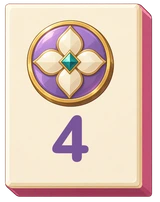
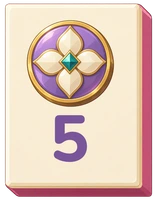
In Riichi, dora are bonus tiles. If the revealed indicator is 4 dots, every 5 dots in your winning hand adds one han to its score.
One 5 dots gives one extra han; two give two. The indicator names the next tile in a fixed cycle. You still need a yaku, such as a dragon triplet, before these bonuses can count.
Indicator
Two dora · +2 han
The 4-dot indicator makes 5 dots dora. Two of them add two han to an eligible winning hand.
Riichi definitions use the 2025 WRC rules. Optional rules and tournament editions can differ.
Also called: indicator tile, dora hyoujihai
Japanese Riichi
A face-up tile in the dead wall that points to the bonus tile: the next tile in its suit or honour cycle.
An indicator of 4 dots makes 5 dots dora; 9 dots points back to 1 dots. Winds cycle East–South–West–North, and dragons cycle white–green–red. The indicator is not itself the bonus tile it identifies.
Independent American rules guidance. The card publisher and your event remain the authority for a ruling.
Also called: daburu riichi, double reach
Japanese Riichi
Declaring riichi on your first turn before any call has interrupted the opening sequence of play.
Under WRC 2025 this is worth two han instead of ordinary riichi’s one. You still need a closed hand that is one tile from completion and must make the riichi declaration and deposit.
Independent American rules guidance. The card publisher and your event remain the authority for a ruling.
Also called: exposed grouping, called group
American
A group laid face up on your rack after calling a tile in American mah jongg.
For example, you call a discarded 5 dots to complete a kong and place all four tiles on top of the rack. Once exposed, that group must continue to fit the card hand you are building.
Independent American rules guidance. The card publisher and your event remain the authority for a ruling.
Also called: fan, 番, Hong Kong points
Hong Kong
The scoring units earned by recognised hand features in Hong Kong mahjong, then converted into a payment.
A qualifying dragon pung commonly contributes one faan. The Hé Fēn New Style sheet normally requires three faan to win; other Hong Kong tables set different minimums, values and payment scales.
The New Style sheet used in Hé Fēn. Old Style and local house tables may differ.
Also called: fan, scoring elements, MCR fan
Chinese Official · MCR
One of MCR’s 81 scoring elements: a feature of the hand or win that contributes a stated number of points.
For example, All Simples is worth two points in the 2006 rules. Add only compatible elements; “fan” here names the scoring elements, not Hong Kong’s faan-to-payment scale.
The WMO 2006 Green Book, hosted by the German Mahjong League. Later editions and event regulations may differ.
Also called: flower draw, buhua, 補花
Taiwanese Classic · Taiwanese Club · Hong Kong · Chinese Official · MCR
Putting a drawn flower or season face up beside your hand and drawing another tile in its place.
In games using this procedure, the flower becomes a bonus tile instead of occupying a space in your main hand. If its replacement is another bonus tile, repeat. American card play keeps flowers in the hand instead.
The Classic scoring sheet used in Hé Fēn; not a universal Taiwanese tournament standard.
Also called: flower tiles, hua, 花牌
Across the rulesets
Decorative tiles whose use depends on the ruleset: often bonus tiles, but part of the hand in American play.
In MCR and many Taiwanese or Hong Kong games, drawn flowers are exposed and replaced. American players keep and use them according to the card; standard four-player Riichi does not use them.
Original teaching explanations. A decision depends on your hand, the rules and the information available.
Also called: minipoints, 符
Japanese Riichi
Riichi minipoints earned for details of a winning hand, such as triplets, the pair and the type of wait.
Most hands start with 20 fu. For example, an open triplet of a simple tile adds two fu. The total is normally rounded up to the next ten; seven pairs is fixed at 25 fu, and pinfu has special treatment. Han and fu together determine payments below the limit tiers.
The WMO 2006 Green Book, hosted by the German Mahjong League. Later editions and event regulations may differ.
Also called: discard-win restriction, 振聴
Japanese Riichi
A Riichi restriction that stops you winning on another player’s discard, most often because you previously discarded one of your current winning tiles.
If you can complete on 3 or 6 bamboo and have discarded 3 bamboo, you cannot win by ron on either tile. You may still win by drawing a completing tile yourself. Passing a completing tile can also cause furiten.
Riichi definitions use the 2025 WRC rules. Optional rules and tournament editions can differ.
Also called: previously discarded tile, 現物
Japanese Riichi
A tile that an opponent has already discarded, making that tile safe from their ron win in Riichi.
If the riichi player previously discarded East, your East is safe against that player because of furiten. Another opponent may still win on it, and it does not prevent a self-draw win.
Riichi definitions use the 2025 WRC rules. Optional rules and tournament editions can differ.
Also called: haitei raoyue, last live-wall draw, 海底摸月
Japanese Riichi
Winning by drawing the final ordinary tile from the Riichi live wall; this earns a yaku.
The key is that no ordinary draws remain after this one. A kong replacement draw has different treatment, and “last tile” does not mean the last unseen copy of a tile identity.
Riichi definitions use the 2025 WRC rules. Optional rules and tournament editions can differ.
Also called: mixed one suit, honitsu, 混一色
Set-based mahjong
A hand using one numbered suit together with honours.
Flowers set aside as bonus tiles are accounted for separately. The pattern’s value, minimum requirements and open-hand treatment depend on the ruleset.
A fragment showing one suit plus honours; not a complete hand.
The WMO 2006 Green Book, hosted by the German Mahjong League. Later editions and event regulations may differ.
Also called: fan in Riichi, 飜, 翻
Japanese Riichi
The Riichi scoring units you add up from yaku and bonus tiles before calculating a hand’s payment.
A dragon triplet supplies one han. If that hand also contains two dora, they add two more, making three han. Below the limit tiers, the fu total also affects what the winner receives.
Independent American rules guidance. The card publisher and your event remain the authority for a ruling.
Also called: hand score, base score
Across the rulesets
The score earned by a winning hand’s patterns and bonuses, before working out who pays whom.
A hand may be described as three han in Riichi or two tai at a Taiwanese table. Those numbers belong to different scoring systems and do not represent the same payment.
Riichi definitions use the 2025 WRC rules. Optional rules and tournament editions can differ.
Also called: repeat counter, continuation counter, 本場
Japanese Riichi
A Riichi repeat counter that adds an extra payment to the next win.
Under WRC 2025, each honba adds 300 points to a ron payment, or 100 from each player on a self-draw. Counters accumulate after dealer wins and drawn hands; they are separate from riichi deposits.
Independent American rules guidance. The card publisher and your event remain the authority for a ruling.
Also called: table rules, house variations
Across the rulesets
Variations agreed by the players for their particular table.
Write down changes to minimums, scoring, claims and payments before play. A familiar local practice should not be silently applied to a different group.
Riichi definitions use the 2025 WRC rules. Optional rules and tournament editions can differ.
Also called: one shot, 一発
Japanese Riichi
Winning soon after declaring riichi: before or on your next draw, with no intervening call to break the chance.
The uninterrupted win earns one additional han under WRC 2025. A sequence, triplet or kong call ends the opportunity, so it does not last for the rest of the hand.
Riichi definitions use the 2025 WRC rules. Optional rules and tournament editions can differ.
Also called: lone tile, singleton tile
Set-based mahjong
A tile with no matching copy or nearby suited tile to connect with in your hand.
If you hold 1 bamboo and no other bamboo, it is isolated. Isolation can make a tile a discard candidate, but a lone valuable honour may still be worth keeping.
Riichi definitions use the 2025 WRC rules. Optional rules and tournament editions can differ.
Also called: wild tile, jokers
American
An American mah jongg wild tile that can stand in for a missing tile in an identical group of three or more.
Two 5 dots plus a joker can represent a pung of 5 dots. Under NMJL-style rules, a joker cannot fill a single or pair and cannot be passed in the Charleston.
NMJL-style American play. Use your own current card and the League’s instruction book.
Also called: joker redemption, redeem a joker
American
Swapping a natural tile from your hand for a joker being used as that tile in an exposed group.
If an exposure shows 5 dots, 5 dots and a joker, you can exchange your 5 dots for that joker during your own turn, after drawing or making a permitted claim. Eligible concealed-card hands may exchange too.
The association’s explanation of American joker exchanges; check your table’s adopted rules.
Also called: no-joker hand, jokerless
American
An American winning hand completed without using any jokers.
Under NMJL-style rules, a jokerless bonus can double the hand value. Singles-and-pairs hands are excluded from this extra bonus because they cannot use jokers in the first place.
Independent American guidance covering hand payments and jokerless bonuses.
Also called: tile wall defence, wall defence, 壁
Japanese Riichi
A Riichi defensive clue: seeing all four copies of a tile rules out opponent sequences that would need it.
If all four 3 dots are visible, an opponent cannot be holding 2–3 dots. That removes one possible way to win on 1 dots, but they could still need 1 dots for a pair or triplet.
Original strategy explanations. Defensive clues are conditional, not universal safety guarantees.
Also called: kandora, kong dora
Japanese Riichi
Extra Riichi bonus tiles identified by a new indicator revealed when a kong is declared.
The new indicator works like the first: it identifies the next tile in its cycle. Multiple indicators can make the same tile dora more than once. The kong’s replacement draw is a separate part of the procedure.
Riichi definitions use the 2025 WRC rules. Optional rules and tournament editions can differ.
Also called: knitted tiles, combination dragon
Chinese Official · MCR
The nine-tile arrangement 1–4–7 in one suit, 2–5–8 in another and 3–6–9 in the third.
These are spaced ranks across three suits, not ordinary chows. The remaining tiles and the complete winning structure must follow the relevant MCR pattern.
One valid assignment of the three knitted suit groups.
The WMO 2006 Green Book, hosted by the German Mahjong League. Later editions and event regulations may differ.
Also called: kan, quad, 槓, 杠
Across the rulesets
A group of four identical tile identities. Its procedure depends on the game.
In set-based games a declared kong needs replacement-tile accounting. An American kong is a four-tile card grouping and does not use that extra-draw procedure.
Independent American rules guidance. The card publisher and your event remain the authority for a ruling.
Also called: last copy, fourth copy, last of its kind
Chinese Official · MCR
Winning with the last available copy of a tile when the other three copies are already publicly visible.
This concerns copies of an identity, not the last draw from the wall. Specific exclusions, including the treatment of a robbed kong, must also be checked.
The WMO 2006 Green Book, hosted by the German Mahjong League. Later editions and event regulations may differ.
Also called: scoring limit, capped hand
Set-based mahjong
A high-scoring hand paid at a fixed tier or maximum rather than continuing the ordinary small-hand calculation.
Riichi’s mangan tier is one example: once a hand reaches it, extra fu does not raise its payment within that tier. Higher named tiers and limits differ between games.
Riichi definitions use the 2025 WRC rules. Optional rules and tournament editions can differ.
Also called: MCR, Chinese Official, guobiao, 國標, 国标
Chinese Official · MCR
The Chinese competition rules with an 81-pattern scoring system and an eight-point qualifying minimum.
Our glossary identifies MCR explicitly because names and score-combination rules can differ from Hong Kong and Riichi. The source here is the WMO 2006 reference.
The WMO 2006 Green Book, hosted by the German Mahjong League. Later editions and event regulations may differ.
Also called: 満貫
Japanese Riichi
A Riichi limit tier with a base value of 2,000 points, reached at five han or certain combinations of fewer han and more fu.
WRC 2025 also rounds four han / 30 fu and three han / 60 fu up to mangan. A non-dealer winning by ron receives 8,000 points before repeat counters; a dealer receives 12,000.
Riichi definitions use the 2025 WRC rules. Optional rules and tournament editions can differ.
Also called: corresponding dragons, same-suit dragons
American
The American card convention associating green dragons with bamboo, red with characters and white with dots.
This is a card-reading convention. The dragon tile does not become a numbered member of that suit. Different-dragon instructions on a card need their own reading.
Independent American rules guidance. The card publisher and your event remain the authority for a ruling.
Also called: own flower, seat flower, flower number
Taiwanese Classic · Taiwanese Club · Hong Kong
A flower or season whose printed number matches your seat, earning a seat-related bonus where the rules use one.
The common mapping is 1 East, 2 South, 3 West and 4 North. Under that convention, the player sitting South matches a number-2 bonus tile. Check which flower bonuses your table awards.
The New Style sheet used in Hé Fēn. Old Style and local house tables may differ.
Also called: eight points, 8-point minimum
Chinese Official · MCR
The requirement to have at least eight qualifying points before declaring an MCR win.
Flower points are added after qualification and cannot make an otherwise seven-point hand eligible. The starting payment component is also separate from the hand’s qualifying points.
The WMO 2006 Green Book, hosted by the German Mahjong League. Later editions and event regulations may differ.
Also called: minimum to win, qualifying minimum, minimum points
Set-based mahjong
The lowest score a completed hand must reach before you are allowed to declare a win.
A valid shape worth seven qualifying MCR points is still short of its eight-point minimum. Hé Fēn’s Taiwanese Classic has no minimum tai; Club uses a separate round-based points requirement.
The WMO 2006 Green Book, hosted by the German Mahjong League. Later editions and event regulations may differ.
Also called: implied patterns, non-repeat principle
Chinese Official · MCR
In MCR, a larger pattern cannot also collect points for a smaller feature that it automatically includes.
For example, Full Flush already means the hand has no honour tiles, so No Honors is not an extra bonus. A genuinely separate compatible feature may still count.
The WMO 2006 Green Book, hosted by the German Mahjong League. Later editions and event regulations may differ.
Also called: unbreakable principle
Chinese Official · MCR
In MCR, you must use one consistent arrangement of your tiles when adding up the score.
The same 333444555 characters can be read as three triplets or three identical 345 sequences. Choose a valid interpretation; you cannot score the triplets and then rearrange those same tiles to score the sequences too.
The WMO 2006 Green Book, hosted by the German Mahjong League. Later editions and event regulations may differ.
Also called: not ready, no-ten, ノーテン
Japanese Riichi
Not ready to win: the hand still needs more than one completing tile when readiness is checked.
At a Riichi exhaustive draw, players reveal hands to establish who is tenpai and who is noten. WRC 2025 has additional readiness conditions, so use its full definition when checking a disputed hand.
Riichi definitions use the 2025 WRC rules. Optional rules and tournament editions can differ.
Also called: open, called hand
Set-based mahjong
A hand in which you have called a discard to make an exposed group, such as a chow or pung.
Calling a third East and laying out the three Easts opens your hand. Your other tiles stay hidden, but closed-only scoring options may now be unavailable.
Independent American rules guidance. The card publisher and your event remain the authority for a ruling.
Also called: single wait, tanki, pair completion, 單騎, 単騎
Set-based mahjong
Waiting for a second copy of one tile to finish the pair in your winning hand.
If your sets are finished and you have one East left, another East completes the pair. A whole hand can have other possible arrangements, so inspect it before counting the waits.
Original teaching explanations. A decision depends on your hand, the rules and the information available.
Also called: settlement, payout
Across the rulesets
The points or agreed stakes transferred after a hand.
Find the hand value first, then apply the correct settlement method. Do not transfer a payment formula from another variant just because it uses similar scoring words.
The WMO 2006 Green Book, hosted by the German Mahjong League. Later editions and event regulations may differ.
Also called: pong, pon, triplet, 碰
Across the rulesets
Three matching tiles, such as three red dragons or three 5 dots.
If you already hold two matching tiles, you can usually call a discarded third to form an exposed pung. American jokers can substitute where permitted; standard Riichi has no jokers.
Independent American rules guidance. The card publisher and your event remain the authority for a ruling.
Also called: push fold, pushing
Across the rulesets
Choosing whether to keep pursuing your win or switch to safer discards to avoid losing to an opponent.
A nearly ready, valuable hand may justify some risk. A distant hand facing a dangerous opponent may not. Compare both hands’ likely prospects and the points situation.
Original teaching explanations. A decision depends on your hand, the rules and the information available.
Also called: quintuplet, five-of-a-kind
American
A five-tile identical grouping required by a card hand.
There are only four natural copies of a numbered tile identity, so a quint of that identity needs joker substitution. Follow the printed hand’s instructions.
Independent American rules guidance. The card publisher and your event remain the authority for a ruling.
Also called: tenpai, listening, ting, 聽牌, 听牌
Set-based mahjong
A hand that needs just one suitable tile to complete its winning shape; called tenpai in Riichi or ting in Chinese play.
For example, with all other groups complete, 4–5 bamboo is waiting for 3 or 6 bamboo. Having the shape ready does not remove a point minimum, yaku requirement or discard-win restriction.
The WMO 2006 Green Book, hosted by the German Mahjong League. Later editions and event regulations may differ.
Also called: supplement tile, supplemental draw
Set-based mahjong
The extra tile you draw after declaring a kong or setting aside a flower, to restore the hand to its proper size.
A kong uses four tiles but fills one group’s place in a standard hand, so it needs a replacement draw. Take that tile from the location your rules specify. American card kongs do not use this procedure.
The WMO 2006 Green Book, hosted by the German Mahjong League. Later editions and event regulations may differ.
Also called: reach, rīchi, 立直
Japanese Riichi
Declaring that your closed Riichi hand needs just one tile to finish, placing a 1,000-point stake and committing to restricted play.
The declaration supplies a yaku. After riichi, you normally discard each new draw unless it wins; certain concealed kongs are exceptions. You cannot freely change your hand as you could before the declaration.
Riichi definitions use the 2025 WRC rules. Optional rules and tournament editions can differ.
Also called: permanent furiten after riichi
Japanese Riichi
Losing the right to win on a discard for the rest of the hand after passing a completing tile while in riichi.
If you declare riichi waiting for 3 or 6 bamboo and pass a 3 bamboo, a later 6 bamboo discard cannot rescue you. You must draw your own completing tile to win.
Riichi definitions use the 2025 WRC rules. Optional rules and tournament editions can differ.
Also called: rinshan, after a kong, 嶺上開花
Japanese Riichi
Winning with the replacement tile drawn immediately after a kong; this earns a Riichi yaku.
Declare a valid kong, take the replacement draw, and if that tile completes an eligible hand, declare tsumo. An ordinary draw on a later turn does not count.
Riichi definitions use the 2025 WRC rules. Optional rules and tournament editions can differ.
Also called: robbing a quad, qianggang, 搶槓
Set-based mahjong
Winning on the tile another player is adding to an exposed pung to turn it into a kong.
The win interrupts the upgrade. For example, an added 5 dots could complete your waiting 4–6 dots sequence. The common added-kong case is allowed across these games, while any concealed-kong exception needs a specific rules check.
Independent American rules guidance. The card publisher and your event remain the authority for a ruling.
Also called: safe discard, anpai
Across the rulesets
A tile you can discard without letting a particular opponent win on that discard, or one judged less risky than your alternatives.
Separate proof from a guess. In Riichi, an opponent’s own discarded tile is protected by furiten; suji is only a clue. Safety against one player does not make a tile safe against everyone.
Riichi definitions use the 2025 WRC rules. Optional rules and tournament editions can differ.
Also called: hand pattern, scoring condition
Set-based mahjong
A feature of a winning hand that earns points, such as a dragon triplet or using only one suit.
The same feature can have different values in different games. Some features already include smaller ones, so spotting both does not always mean you can add both scores.
The WMO 2006 Green Book, hosted by the German Mahjong League. Later editions and event regulations may differ.
Also called: spring, summer, autumn, fall, winter
Across the rulesets
Four decorative tiles representing the seasons, included in some mahjong sets.
Their treatment depends on the game. Some traditions distinguish flowers from seasons for bonuses; American sets generally treat these decorative tiles as flowers.
Seasons belong to the extra tiles, not the numbered suits.
Independent American rules guidance. The card publisher and your event remain the authority for a ruling.
Also called: own wind, jikaze, 自風
Set-based mahjong
Your assigned position at the table: East, South, West or North. It can make your matching wind group worth extra.
If you sit South, a South pung may score as your own wind. Your seat can change when the dealer rotates, regardless of which physical chair you occupy.
Independent American rules guidance. The card publisher and your event remain the authority for a ruling.
Also called: chiitoitsu, chiitoi, 七對, 七対子
Japanese Riichi · Hong Kong · Chinese Official · MCR
A special 14-tile shape built from seven pairs rather than four sets and a pair.
Riichi requires seven distinct tile identities. MCR can count four identical tiles as two pairs. Qualification and value must be checked in the chosen game.
Riichi definitions use the 2025 WRC rules. Optional rules and tournament editions can differ.
Also called: xiangting, iishanten, one shanten, 向聴
Japanese Riichi
How many hand improvements you need to reach a ready hand in Riichi. Zero shanten means ready; one shanten means one improvement away.
An improvement usually involves drawing a useful tile and discarding another. Reaching zero shanten means you are waiting for the winning tile, not that you have already won.
Independent American rules guidance. The card publisher and your event remain the authority for a ruling.
Also called: suji defence, suji defense, 筋
Japanese Riichi
A Riichi defensive clue that uses an opponent’s discarded number to rule out some two-sided waits.
If they discarded 6 bamboo, furiten prevents a ron on 3 bamboo from a 4–5 wait, because that shape also wins on 6. But 3 bamboo could still complete a pair or a different wait, so it is not guaranteed safe.
Original strategy explanations. Defensive clues are conditional, not universal safety guarantees.
Also called: 台, 臺, Taiwanese points
Taiwanese Classic · Taiwanese Club
The units earned for scoring features in Taiwanese mahjong, such as matching wind groups or a closed hand.
Add the tai awarded by your table’s sheet, then use its base stake and per-tai payment rate. Hé Fēn’s Classic uses this approach; the Club house sheet uses a different flat-points system.
Riichi definitions use the 2025 WRC rules. Optional rules and tournament editions can differ.
Also called: same-turn furiten, temporary ron restriction
Japanese Riichi
A short-lived Riichi restriction on winning by discard after you pass a tile that could complete your hand.
Under WRC 2025, it lasts until your next draw or call. It applies even if that completing tile gave you no yaku, and includes a missed chance to rob a kong. After a riichi declaration, the restriction instead lasts to the end of the hand.
The WMO 2006 Green Book, hosted by the German Mahjong League. Later editions and event regulations may differ.
Also called: remaining copies, live outs, visible tiles
Across the rulesets
How many useful copies might still be obtainable after accounting for tiles you can see.
There are four natural copies of a numbered tile. If you hold one 5 dots and can see two more in discards or exposures, only one is unaccounted for. An opponent might hold it; it is not guaranteed to remain in the wall.
Original teaching explanations. A decision depends on your hand, the rules and the information available.
Also called: block, partial group, shape
Set-based mahjong
A small group you consider together while building a hand, such as a pair, a completed set or two connected tiles.
You might read 4–5 bamboo as one unfinished block and two Easts as another. This makes the hand easier to plan without fixing its final arrangement too early.
Original teaching explanations. A decision depends on your hand, the rules and the information available.
Also called: efficiency, hand development
Set-based mahjong
Keeping the shapes that give you useful ways to improve your hand on future draws.
For a simple sequence example, 4–5 accepts 3 or 6, while 4–6 accepts only 5. More useful draws often mean faster progress, but hand value, visible tiles and danger can change the best discard.
Original teaching explanations. A decision depends on your hand, the rules and the information available.
Also called: four of a kind not declared, four identical tiles
Chinese Official · MCR
Using all four copies of one tile in your winning MCR hand without declaring a kong.
For example, 345 characters, another 345 characters and a pair of 4 characters use all four 4s in separate groups. This feature is worth two points in the 2006 rules, subject to the scoring exclusions.
The WMO 2006 Green Book, hosted by the German Mahjong League. Later editions and event regulations may differ.
Also called: m p s, 123m, tile codes
Across the rulesets
A compact way of writing tile identities: m for characters, p for dots and s for bamboo.
For example, 345s describes three, four and five bamboo. On this site E/S/W/N are winds and RD/GD/WD are dragons. This is notation, not a scoring rule.
Original teaching explanations. A decision depends on your hand, the rules and the information available.
Also called: tile acceptance, improving tiles, 受け入れ
Japanese Riichi
The number of tile copies that would move a Riichi hand closer to ready—or complete it if it is already ready.
A simple 4–5 bamboo wait has up to eight completing copies: four 3s and four 6s. Subtract copies you can see when estimating actual availability. In more complex hands, count only draws that improve the whole hand.
Independent American rules guidance. The card publisher and your event remain the authority for a ruling.
Also called: qualifying pattern, 役
Japanese Riichi
A recognised Riichi hand feature or winning circumstance, such as a dragon triplet or declaring riichi. You need at least one to win.
Four sets and a pair can make a complete shape without a yaku. Dora then adds nothing useful until the hand has a qualifying feature. Some yaku require the hand to stay closed.
These are original Hé Fēn explanations, with rulebook references and our own tile examples. Riichi entries follow the WRC 2025 edition; MCR entries use the 2006 Green Book. American terms describe NMJL-style play.
Taiwanese Classic, Club and Hong Kong filters include the sheets used in Hé Fēn. Local tables and tournament editions can differ. Each entry explains its scope.